What is a circular economy and how can we apply this systems thinking approach to our professional practice?
Hosted on Kaurna land
Author: Kerry Reed
Presenter: Yaara Plaves
Hosts: Yaara Plaves, Senior Architect with Hames Sharley and head of the National Sustainability Forum and Tyler Lawrence, Engineer with Lucid Consulting.
Session Date: Tuesday 27th October 2020
Fast Facts
- A circular economy is driven by renewable flows of energy and materials, where the idea of waste is eliminated.
- In 2016/17 the Australian construction industry was responsible for over 30% of all waste (1). We have an opportunity to make a significant contribution to reducing waste and emissions, if built environment professionals can apply a circular economy, systems thinking approach to their work.
- Collaboration is key between many and varied parties right from the start of a project.
- Buildings need to take a long term view and be designed from the start for disassembly.
- We need to challenge the models of ownership and responsibility that work against the implementation of circular economy principles.
Welcome!
Welcome to the very first edition of our ASBN SustainabiliTEA session summaries! Each SustainabiliTEA web session will focus on one topic in detail with a short presentation followed by group questions and discussion. We will then publish this summary blog (with a few bonus extra nuggets of knowledge/links/contacts) after the event so you can dive in if you missed it or revisit it if you were there.
With the craziness and uncertainty of 2020, we want to make sure that we have a way to connect with each other and continue to learn and grow towards more sustainable built environments. ASBN will still be running in-person events as circumstances allow but we want to provide a regular way that anyone from anywhere can connect with us, learn something, share their own experiences and expertise and hopefully form connections too.
So settle down with a cup of your preferred beverage and enjoy this review of our first session focussed on Circular Economy in built environment professional practice.
Introduction
In Australia, we are fortunate to live alongside the oldest living culture in the world. In Adelaide, our Kaurna people have a deep understanding of natural systems and are ancient experts in the notion of circular and systems thinking, the key mindset needed to create a circular economy. Circular economy isn’t really a hot new trend, it is an ancient way of living. There is much we can learn from indigenous Australians as we attempt to shift to a way of using resources in a more sustainable way in the built environment.
A circular economy is driven by renewable flows of energy and materials, where the idea of waste is eliminated. In contrast, our modern linear systems approach takes resources, turns them into products and then throws them away at their end of life. Circular economy aims to close the loop and ensure that resources are kept in use as long as possible (ideally perpetually). On a planet where we have a finite amount of resources, it is the only approach that makes sense.
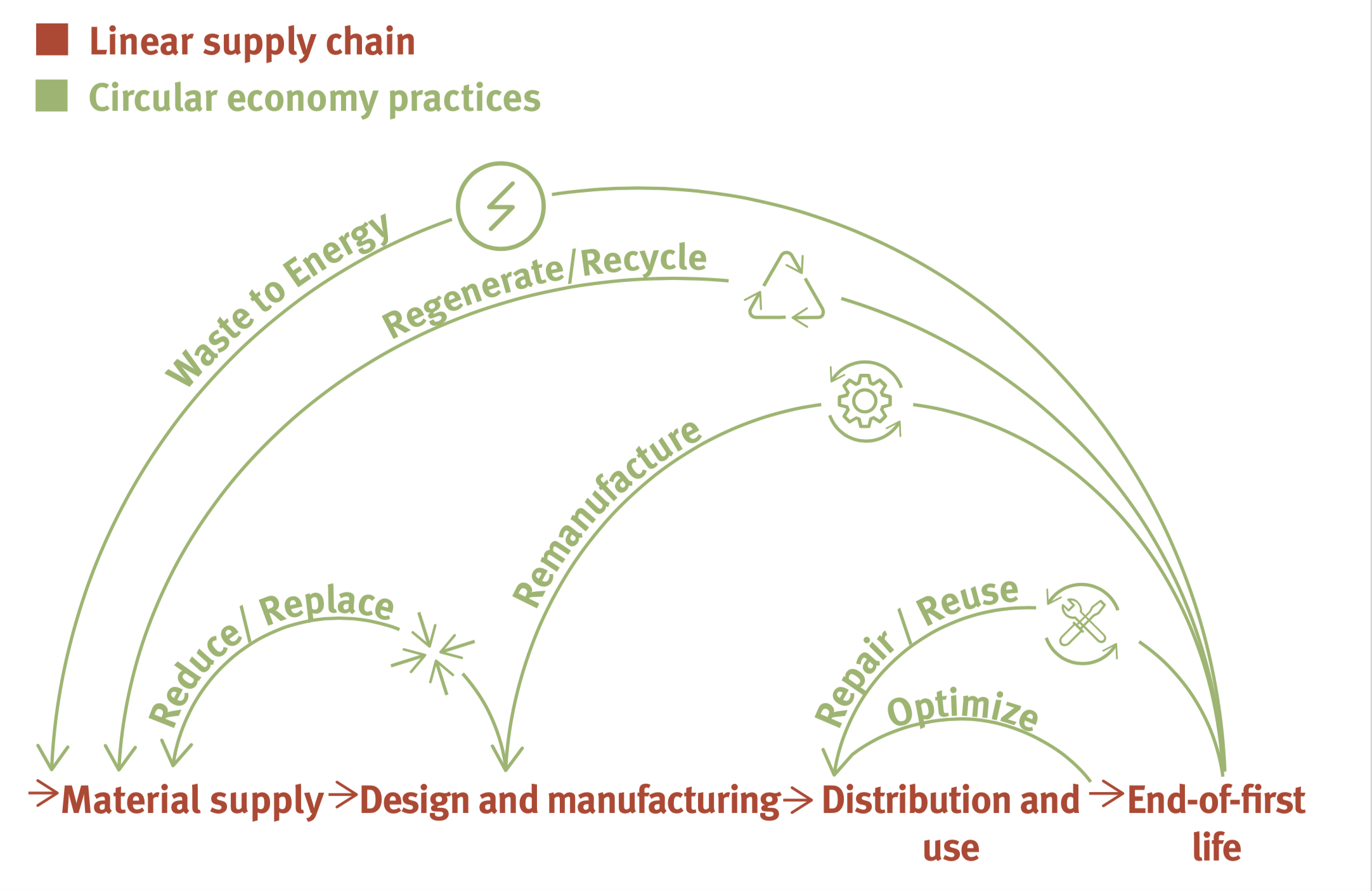
We have grown used to the idea that so long as something can be recycled, we are behaving sustainably. In the circular economy model, it is important to identify that recycling is low in the hierarchy of the best way to use materials. It is much more efficient to design to reduce waste, to create opportunities for disassembly and reuse and enable things to be repaired.

Image source: https://www.mrw.co.uk/knowledge-centre/comment/merging-the-circular-economy-and-waste-hierarchy-11-10-2013/
Applications for Construction Industry
In 2016/17 the Australian construction industry was responsible for over 30% of all waste. This amounted to 20.4MT, of which 6.7MT went to landfill. While a large proportion is recovered, it is often either stockpiled or downgraded into rubble (2). The built environment is also responsible for large amounts of energy use and Greenhouse Gas emissions. We have an opportunity to make a significant contribution to reducing waste and emissions, if built environment professionals can apply a circular economy, systems thinking approach to their work.
One example of how we can change our thinking to create more closed loop systems comes from a project by the Agency of Design in the UK which critically engaged with the processes of design and delivery of products and services. The point of their project was to radically re-imagine how we design and build things through thoughtful and deliberate professional practice, . They applied three different strategies to the design of a household toaster in an attempt to design out waste:
- The Optimist, designed for long life-cycle including repairability and recycling at end of life
- The Pragmatist, designed for modular assemblage, with each module able to fit through a standard UK letterbox slot. Designed for redundancy and flexibility to fit individual needs.
- The Realist, designed for easy disassembly.
From these three concepts, we can draw lessons for the built environment. These include design for durability, disassembly, easy repair, materials that retain value at end of life, modular components (swap in, swap out), easy transport to site and utilising mechanical fixings that allow for disassembly and reuse. Not every lesson will be applicable on every project, but the possibilities are enormous. Buildings constructed of quality materials that can be easily disassembled become a material bank for other projects (see case study below).
Another concept which reimagines our built environments is thinking of buildings as services rather than products. In this model, suppliers/developers/investors maintain some or all responsibility for the asset and maintenance. This allows for various models of ownership and responsibility, dependent on the situation and the stakeholders involved. When developers have responsibility for the building over its lifetime, they are more likely to create efficient and quality buildings.
Questions and Discussion Summary
What would it take for professions in the built environment to change the way we do business to facilitate circular economy?
- Collaboration is key, right from the start of the project, including with less obvious parties such as artists, scientists, business people, waste sorting factories, teachers etc.
- Buildings must be designed for disassembly at end of life. Existing methods of fitting out buildings are very difficult to disassemble and contain many toxic components. Standard sizing of elements may make it easier to reuse elements.
- New models of ownership and responsibility must be explored to overcome issues around maintenance, legal requirements and establishment costs. Examples of existing innovative approaches included the Nightingale model, facades as a service and the Open Building movement in the Netherlands. It was also suggested that corporate clients could retain ownership of the asset or all stakeholders could get together and share the risk, including banks.
- Professionals consulting on projects should be aware of the different models that are available and which might be applicable for different client requirements.
Are manufacturers a consideration with what you are designing and selecting?
- We are stuck in a cycle of wanting better buildings but not wanting to pay for it.
- It is important that firms create or utilise materials lists with sustainable products. The Living Building Challenge Declare platform enables transparency of product information and they have also compiled the Red List – a list of materials to avoid in projects.
- Finishes are getting easier to specify good products as the cost is starting to be neutral. But they are only about 10% of the life cycle analysis of a building. Structure, façade and services are most of the embodied energy (steel, glass, concrete, timber, etc).
Why do we do tiled rooves?
- Really only personal and aesthetic preferences, most likely left over from our heritage. They are more expensive, heavier, higher embodied energy and can be problematic with leaks.
Can we do more adaptive reuse rather than demolish?
- The most sustainable building is the one that already exists.
- Embodied carbon is as important as operational carbon. If you reuse things or make use of existing buildings, then you are saving a lot on carbon.
- When there is a carbon cost, there will be a much bigger financial incentive to reuse over demolish.
- Damian Madigan at Uni SA does a lot of work on adaptive reuse.
Case Studies
Below are the details of the case studies mentioned in the video, plus a bonus case study of local construction industry sustainability champion and ASBN sponsor Precycle.

Image: https://www.precycle.com.au/
Precycle: ASBN sponsors and waste reduction stars
Precycle aim to create an effective way to manage recycling across the construction industry. Through its 6 stage process over the course of a build, Precycle sorts recyclable materials at its source before it becomes contaminated and therefore no longer viable as a recycling/repurposing resource.
You can see more about what they do here: https://www.youtube.com/watch?v=RIuDY2O1NN4&feature=emb_logo

Image: https://www.bamb2020.eu
They aim to make the materials in buildings reusable, ideally without being downgraded. This requires that buildings can be taken apart without damaging materials at the end of their life and that there is some sort of database of the materials that are available in the building. They created a system called Materials Passports to enable this process, although the concept could be applied to any building. This approach enables the investment to pay out twice, firstly as an asset to be leased and secondly as materials at end of life.

Image: https://www.ellenmacarthurfoundation.org/case-studies/a-mobility-revolution-in-wales
Riversimple: transportation as a service
With the goal of “the elimination of the environmental impact of personal transport”, Riversimple reimagined the systems associated with personal transport. They have designed a hydrogen fuel cell car and a business model that sells personal transport as a service rather than a product to own.

Circular City: Dijon France
A Smart city with central management of items such as fire and safety, traffic lights, waste and energy leading to improved efficiency and reduced waste.

Image: https://nightingalehousing.org/nightingale-1
Nightingale: Sustainable housing
These apartments are delivered at cost price and sold only to residents, not investors. They are built to a high energy efficiency standard and located close to services. They aim to create happy, healthy and thriving communities.

Image: https://www.openbuilding.co/
Open Buildings: Sustainable and ethical buildings
Open buildings has been created by a group of Dutch architects and engineers. They aim to create sustainable buildings that are co-created with users and offer models of co-ownership. Designed for adaptability and disassembly, they reduce waste, extend the lifespan of the building and lower emissions.

Image: https://www.fairphone.com/en/
FairPhone: Ethical and sustainable smart phones
Fairphone aims to create smartphones that reduce e-waste (by making them long lasting, repairable, reusable and recyclable) and engage in ethical work practices (for people and the environment).
MORE RESOURCES
There are many organisations worldwide working to educate on and promote circular economy approaches. Below are links to just a few and some useful resources:
Australian Circular Economy Hub
European Circular Economy Stakeholder Platform
SA expert Jodie Bricout
SA expert Dr David Ness
United Nations Industrial Development Organization
EPiC Database of open-access Life Cycle Inventory of environmental flow coefficients for building materials.
REFERENCES
(1) & (2) Department of the Environment and Energy and Blue Environment Pty Ltd, (2018), National Waste Report 2018, https://www.environment.gov.au/system/files/resources/7381c1de-31d0-429b-912c-91a6dbc83af7/files/national-waste-report-2018.pdf
ACKNOWLEDGEMENTS
Video created & edited by Environmental & Science Media